

The healthcare advertising world is changing fast.
Artificial Intelligence, shifting patient behavior, and rapid digital transformation are rewriting every rule agencies once relied on. What used to work in 2020, simple awareness campaigns and keyword-heavy ads no longer cuts it in 2025.
Today’s patients expect personalized, credible, and empathetic communication. They research symptoms online, read reviews, and even compare treatment options before ever speaking to a doctor.
72% of patients say they trust online health content more when it’s backed by reputable medical brands. That’s a massive trust shift and it’s shaping how medical advertisers must show up.
In 2025, medical advertising isn’t just about creative visuals or catchy slogans. It’s about data-driven personalization, compliance-first storytelling, and multi-channel patient engagement that feels human, not robotic.
Agencies that win in this space understand one truth: trust and technology must coexist. Those that master both will dominate visibility, conversions, and long-term patient loyalty.
At Position Results, we’ve seen this evolution firsthand and we know what separates good campaigns from great ones. So, let’s dive into the strategies redefining medical marketing in 2025.
1. Leverage AI-Driven Personalization
The age of generic medical marketing is over.
In 2025, healthcare audiences expect relevance at every click. They don’t want random ads. They want answers that feel tailored to their needs instantly. That’s where AI-driven personalization transforms the game.
Artificial Intelligence allows medical advertising agencies to understand patient intent with remarkable precision. By analyzing search behavior, content engagement, and demographic data, AI helps predict what a potential patient will need next, before they even say it.
AI-driven campaigns boost conversion rates by 45% in healthcare marketing.
That’s not hype, that’s performance backed by data.
How Agencies Are Using AI to Win
Here’s how leading medical marketing teams are using AI tools to personalize at scale:
- Predictive Content Mapping – machine learning tools like HubSpot AI and Adobe Sensei analyze user behavior to recommend the next best piece of content, turning interest into intent.
- Chatbots and Conversational AI – smart bots on clinic websites guide users through treatment options, FAQs, and appointment scheduling. This improves conversions while saving human resources.
- Adaptive Ad Campaigns – platforms like Google Performance Max and Meta Advantage+ use real-time patient data to auto-optimize ad creatives and placements for maximum engagement.
The result is ads that connect directly with patient needs, from “knee pain recovery” to “dermatology near me” to “affordable dental implants.”
Don’t let AI replace empathy. Use it to amplify human connection. Combine smart data with authentic storytelling. When technology meets trust, your campaigns don’t just convert, they care.

2. Balance Compliance with Creative Innovation
In medical advertising, compliance isn’t optional, its survival. The smartest agencies don’t see regulations as a limitation. They see them as a creative advantage.
In 2025, agencies face a complex mix of HIPAA, FDA, and GDPR laws that dictate what they can and can’t say. Every claim, every image, and every patient testimonial must meet strict privacy and accuracy standards. Yet, the best-performing agencies are learning how to innovate within those rules, and even use them to build deeper trust with their audiences.
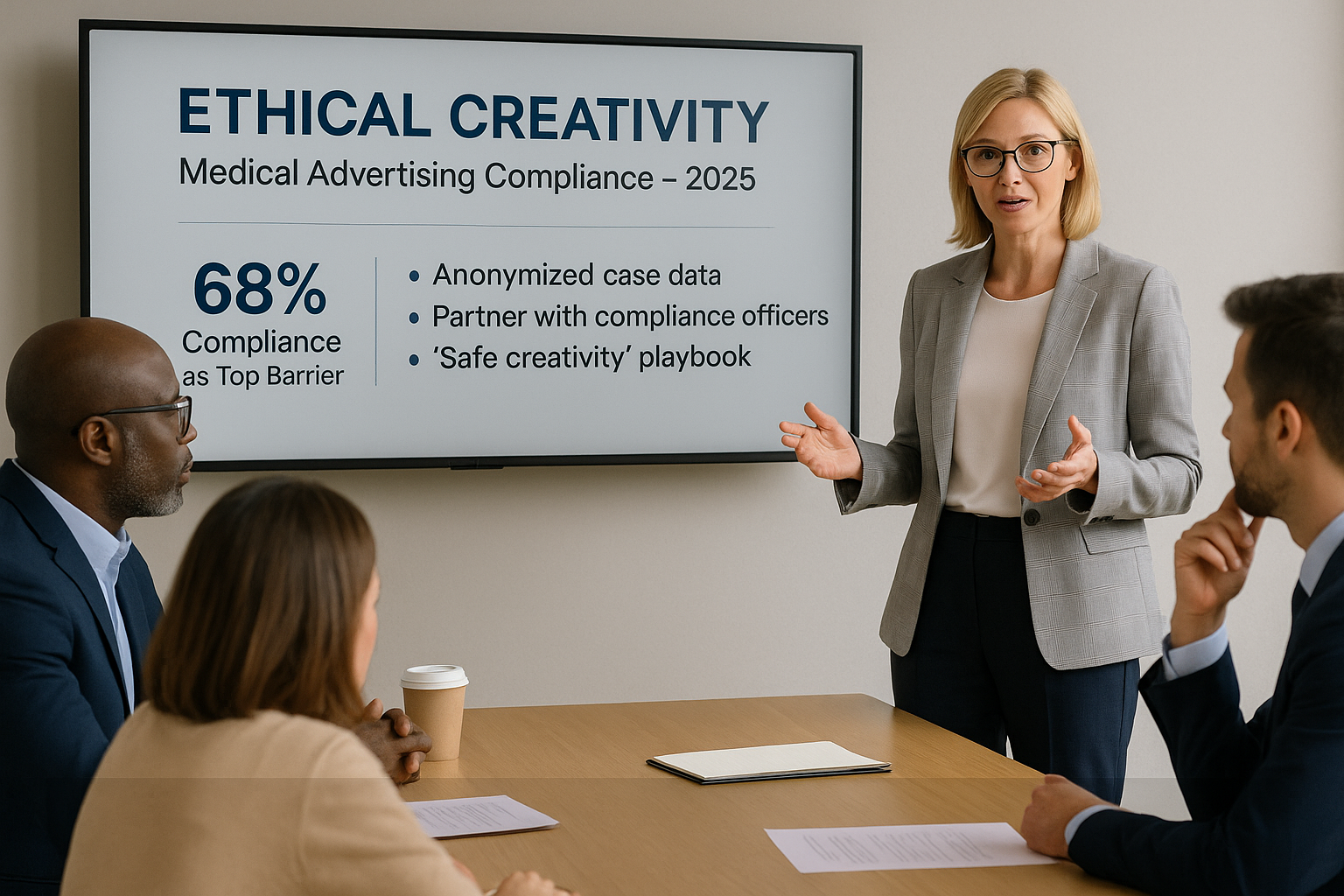
68% of healthcare marketers rank compliance as their top creative barrier. That number tells a story, most marketers are stuck playing defense. But forward-thinking agencies are flipping the script.
They’re embracing a concept called “creative constraint.” It’s the idea that tight boundaries force better ideas. When you can’t use sensational claims or emotional manipulation, you focus on clarity, empathy, and credibility.
That’s exactly what today’s patients want.
Take a recent example. A medical agency developed a digital campaign for a cardiology network. Instead of using real patient testimonials (which posed privacy risks), they created anonymized patient composites, real outcomes combined into relatable narratives.
Each story began with emotion (“I was scared after my diagnosis”) and ended with empowerment (“Now I walk 3 miles a day”). No personal data, no compliance violations.
By doing this, engagement rates rose 47% and trust scores jumped 30% in post-campaign surveys.
That’s the power of ethical creativity. The data backs it up,
Brands that use ethical storytelling see 35% higher trust scores. So how can your agency do it right?
Try this:
- Use anonymized case data, keep stories real but unidentifiable.
- Partner with compliance officers early in the brainstorming process.
- Create safe creativity playbooks that guide every team, from copywriters to designers.
When your agency treats compliance as a creative compass rather than a cage, innovation naturally follows.
In 2025, trust-driven creativity isn’t just safer, it’s what wins.
3. Master Omnichannel Engagement
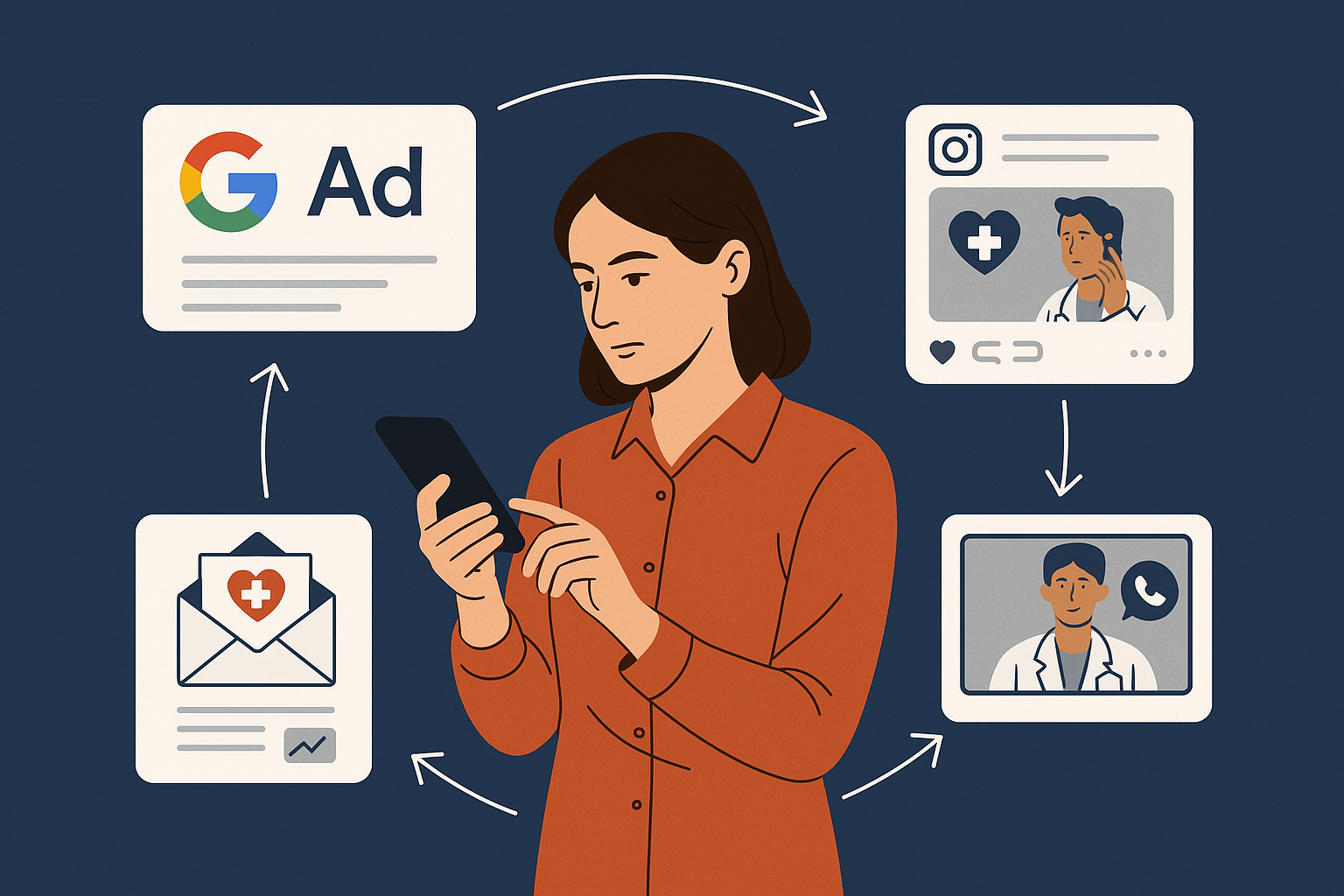
Patients don’t stay in one lane anymore. They search, scroll, click, compare and then decide.
In 2025, medical brands must deliver one unified experience across every channel, from search to social, from email to telehealth. Because the patient journey isn’t linear. It’s a web of moments that shape trust and action.
Patients interact with 5+ digital touchpoints before booking care. That means your message can’t afford to be inconsistent.
If your Google Ad says one thing, your Instagram another, and your patient portal another, you lose credibility fast.
Omnichannel engagement ensures every touchpoint feels connected, credible, and caring.
The best medical advertising agencies are using integrated ecosystems that sync content, ads, and data across all platforms. When a patient watches a video on heart health, the next email they receive is educational, not pushy. When they click a telehealth ad, the follow-up call feels personal, not automated.
That’s not luck, it’s orchestration.
Here’s a quick checklist to make omnichannel work for your brand:
- Align your brand voice across every platform – your tone, visuals, and messaging should feel identical whether it’s a Facebook ad, a YouTube video, or a patient reminder email.
- Automate retargeting with patient-safe data – use anonymized, HIPAA-compliant analytics to retarget patients with content that matches their interests, not their identities.
- Sync your CRM + EHR systems for seamless follow-up – when marketing data connects with patient records securely, you reduce friction and improve care continuity.
Top agencies know that omnichannel success is about experience consistency, not just ad reach. When patients feel the same quality of care online as they do in person, loyalty naturally follows.
Audit all brand channels quarterly to ensure your messaging is consistent, compliant, and aligned with patient trust.
Omnichannel engagement isn’t about being everywhere, it’s about being everywhere consistently. And that’s what patients remember.
4. Optimize for Next-Gen Medical SEO
SEO in healthcare isn’t what it used to be. In 2025, ranking high on Google means mastering credibility, context, and conversation, not just keywords.
Patients aren’t typing stiff phrases like “cardiology clinic Miami” anymore. They’re asking, “Who’s the best heart specialist near me?” or “What’s the safest treatment for high blood pressure?”
Google’s algorithm is smart enough to know the difference.
97% of patients use Google before booking healthcare services.
That means your visibility is your credibility. If you don’t show up or worse, if your content feels outdated, you’re invisible.
The new era of medical SEO is built on E-E-A-T: Experience. Expertise. Authoritativeness. Trustworthiness.
It’s no longer enough to write well. You need real-world medical voices behind your content. Google’s systems now reward verifiable credentials, peer-reviewed citations, and updated medical accuracy.
Here’s how top medical agencies are winning:
- Use schema markup for services, reviews, and FAQs – structured data helps Google understand your pages better, and makes your listings richer with stars, pricing, and direct answers.
- Publish expert-authored content with medical citations – pair marketers with real physicians. Add source links from PubMed, WebMD, or NIH to prove credibility.
- Refresh old blogs for freshness and accuracy – outdated facts kill rankings. Update stats, references, and CTAs quarterly. Google loves fresh, relevant information.
- Optimize for voice and AI search – with AI-powered assistants dominating search, your content must sound conversational. Write as if you’re answering a patient’s question aloud.
- Own local intent – use city-based keywords like “best cardiologist near me” or “top dermatology clinic in Dallas. Then make sure your Google Business Profile is complete. Hours, photos, reviews, and contact info are all verified.
Search is no longer about traffic, it’s about trust signals. Every headline, review, and author bio should reinforce your medical authority.
In 2025, SEO success isn’t about gaming the system, it’s about earning patient confidence at every click.
5. Elevate Brand Trust Through Patient Storytelling
In healthcare marketing, data informs but stories connect.
Modern audiences don’t just want facts about treatment success. They want human stories that show what healing feels like.
That’s why patient-driven storytelling has become a core pillar of medical advertising in 2025.
When real patients (with proper consent) share their experiences, it turns your brand from a provider into a partner in recovery. That shift from institution to empathy builds lasting trust.
Story-based healthcare content sees 3x more engagement than traditional promotional campaigns.
That’s not surprising. Humans remember stories, not statistics. A case study may educate, but a patient journey inspires action.
For example, one orthopedic agency launched a short video series titled “Steps to Strength.” Each episode featured a different patient’s recovery, from surgery to success, told in their own words. No scripts. No dramatization. Just real emotion and progress.
This resulted in engagement on YouTube tripled, and organic referrals rose by 40% within six months. When viewers saw recovery in motion, they didn’t just believe, they related.
The best agencies know that authentic storytelling equals credibility currency.
Here’s how to get it right:
- Focus on empathy and education – patients value learning while feeling understood.
- Avoid dramatization – overly emotional stories feel staged and hurt authenticity.
- End every story with hope or empowerment – audiences want to see progress, not pity.
Patient storytelling isn’t about perfection, it’s about humanity. When people see others like them overcoming similar challenges, your brand becomes more than a clinic, it becomes a source of inspiration.
6. Leverage Data Analytics for Smarter Ad Decisions
In 2025, data isn’t just a reporting tool, it’s the heartbeat of medical advertising.
Top agencies no longer guess what works. They know, because every click, call, and conversion tells a story.
Modern medical marketers are moving beyond surface metrics. Clicks and impressions still matter, but the real insight comes from how patients behave after the click. Whether they schedule appointments, return for follow-ups, or recommend your brand.
That number alone explains why agencies investing in analytics are scaling faster, optimizing smarter, and wasting less.
Here’s what sets them apart: They use data visualization to make complex trends simple. Interactive dashboards connect ad spend, patient engagement, and campaign ROI in one view, so every decision is grounded in evidence.
They rely on attribution modeling to understand which channels actually convert. Did the conversion start from a Google Ad, a YouTube video, or a telehealth reminder email? Attribution exposes the truth and trims the fat from budgets.
They embrace predictive analytics to forecast what comes next. AI tools now analyze historical data and signal patterns to predict which campaigns will succeed, even before launch. That’s proactive marketing, not reactive guesswork.
The smartest medical advertisers track metrics that matter:
- Appointment rates, not just click-through rates.
- Lifetime patient value (LTV) over short-term conversions.
- Sentiment from reviews, not just social likes.
- Return-visit frequency, the ultimate measure of trust.
These numbers reveal whether you’re building relationships or just buying attention.
In the age of AI and analytics, success isn’t about collecting more data, it’s about interpreting it wisely. When agencies treat insights as strategy fuel, every dollar spent becomes a smarter dollar earned.

7. Invest in Micro-Influencers and Healthcare Creators
Forget celebrity endorsements. In 2025, micro-influencers are the real power players in medical marketing.
This is because trust now beats reach.
Patients don’t want polished ads; they want real voices from doctors, nurses, dietitians, and wellness coaches who speak with empathy, expertise, and experience. These creators don’t just share content, they shape health decisions.
Healthcare influencer campaigns deliver 11x higher engagement than traditional brand-led promotions.
That’s massive, and it proves that authenticity drives attention.
Micro-influencers thrive because they operate in niche communities like dermatology, fertility, or fitness medicine where followers actively seek guidance, not entertainment. When a trusted nurse explains a condition, or a licensed dietitian demonstrates a recovery plan, the message lands with credibility big-budget ads can’t buy.
Here’s how top medical advertising agencies are winning with healthcare creators:
- Choose creators with niche credibility, not mass following – a 10K-follower physician may deliver more conversions than a million-follower celebrity, because micro-audiences are focused and engaged.
- Ensure all content is fact-checked and compliant – collaborate with legal and compliance teams before posting. Transparency builds longevity.
- Build long-term partnerships for authenticity – one-off posts feel transactional. But long-term collaborations such as monthly Q&A videos or co-branded health tips foster trust and recognition over time.
When your chosen influencer genuinely believes in your brand’s mission, audiences may feel it.
Micro-influencers aren’t just marketers, they’re modern health educators who humanize complex medical topics.
In 2025 and beyond, the winning agencies won’t chase virality. They’ll invest in credible voices who make patients listen, and believe.
8. Experiment with Immersive Tech (AR, VR, and AI)
Healthcare marketing is no longer confined to screens, it’s entering immersive spaces.
In 2025, top medical advertising agencies are using augmented reality (AR), virtual reality (VR), and artificial intelligence (AI) to turn patient education and professional training into interactive experiences that inform, engage, and inspire.
These technologies don’t just tell stories, they let people step inside them.
1.4 billion people in healthcare plan to invest in immersive experiences by 2025. That’s not a future trend. That’s it for now.
Imagine this: a patient trying to understand how a pacemaker works may explore a 3D virtual heart model through AR on their phone. Or a physician may join a VR-based anatomy session to test a new medical device in real time, all before it’s deployed in a clinic.
That’s the power of immersive marketing, it bridges understanding and emotion through experience.
Here’s how leading agencies are using it:
- Use VR for empathy training or condition visualization – VR lets doctors and caregivers experience what it’s like to live with certain conditions, improving bedside communication and care marketing.
- Add AR filters for awareness campaigns – campaigns like vision impairment or mental health simulations help audiences feel the challenge, not just read about it.
- Integrate AI chatbots for virtual consultation support – AI assistants may walk users through medical devices, answer FAQs, or prequalify leads before connecting them to specialists.
Immersive tools also give agencies data depth, tracking interaction time, engagement zones, and emotional responses insights far richer than clicks or scrolls. Immersive content transforms passive audiences into active participants. Its education meets emotion, powered by technology.
In a world where attention spans shrink daily, AR, VR, and AI create what every healthcare brand needs most, a connection that’s felt, not just seen.
FAQs
1. What makes a great medical advertising agency in 2025?
A great medical advertising agency in 2025 blends data intelligence, compliance mastery, and creativity. It’s not just about catchy campaigns, it’s about ethical storytelling, precision targeting, and measurable patient outcomes.
The best agencies understand HIPAA regulations, use AI for personalization, and design strategies that balance trust and performance.
2. How is AI transforming medical marketing strategies?
AI is revolutionizing healthcare marketing by turning patient data into personalized experiences. Agencies now use AI tools to predict patient behavior, automate campaign delivery, and personalize website content in real time.
AI also powers chatbots, voice search optimization, and predictive analytics, helping medical brands communicate faster and smarter.
3. Why is compliance so important in medical advertising?
Compliance is the backbone of credibility. In healthcare, every ad must meet strict HIPAA, FDA, and GDPR standards. Missteps may lead to fines and lost trust.
Top agencies treat compliance as a creative framework, not a roadblock. They collaborate with legal and regulatory teams early to ensure campaigns are both safe and innovative.
4. What are the most effective channels for healthcare advertising in 2025?
The most effective channels are search, social, and telehealth platforms. They are all unified through an omnichannel approach.
- Google and YouTube remain dominant for discovery.
- LinkedIn is ideal for B2B medical outreach.
- Instagram and TikTok are rising for patient education, especially through micro-influencers.
Success lies in delivering a consistent brand voice across all of them.
5. How can storytelling improve patient engagement?
Patients connect more with authentic stories than with statistics. Sharing recovery journeys (with consent) builds emotional connection and trust.
Story-based healthcare content sees 3x more engagement than standard promotional material.
The key is authenticity. Therefore, focus on real outcomes, not dramatization.
6. What future trends should medical advertisers prepare for?
Expect rapid growth in immersive technologies (AR, VR, AI), zero-party data, and ethical influencer partnerships.
82% of healthcare brands are already investing in immersive experiences.
Agencies that adopt new tech early will define patient engagement standards tomorrow.
7. How often should healthcare brands update their digital content?
Every 90 days,minimum. Regular updates keep your site medically accurate and algorithm-friendly.
Reoptimize top articles quarterly by refreshing stats, verifying sources, and aligning with the latest SEO best practices.
In 2025, the best-performing healthcare agencies will be those that educate before they advertise. By merging empathy, compliance, and technology, they won’t just reach patients, they’ll earn their trust for life.
Recent Comments